
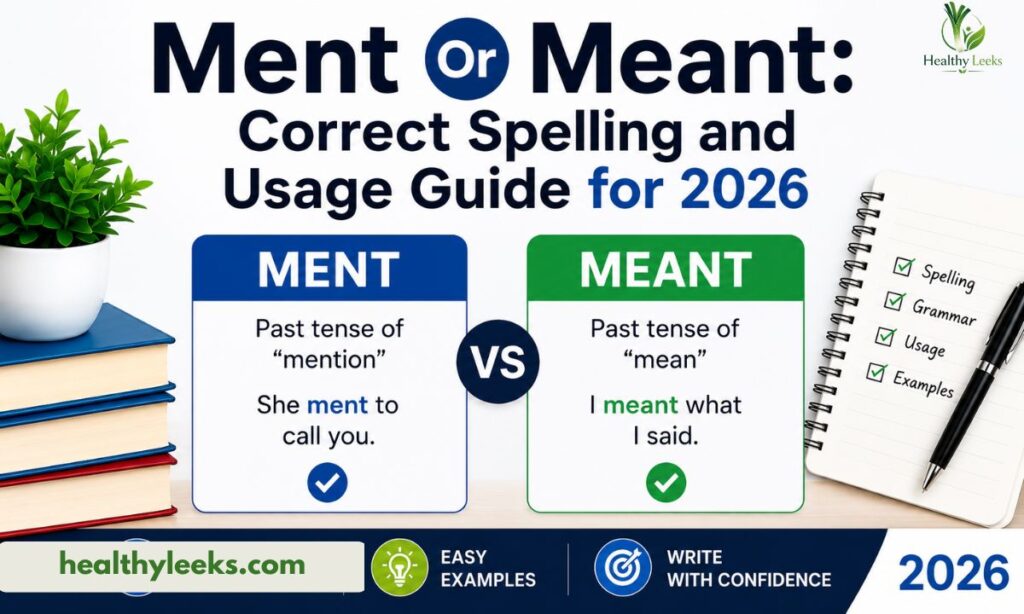

Have you ever typed “I ment to call you” and then paused, not sure if that looks right? You’re definitely not alone. The confusion between ment or meant is one of the most common spelling mix-ups in everyday English, and it catches both native speakers and English learners off guard.
The good news? The answer is simple, and once you learn the rule, you’ll never second-guess yourself again. This guide breaks down the correct spelling, meaning, origin, common mistakes, and real-world examples so you can write with total confidence in 2026.
Ment Or Meant – Quick Answer
“Meant” is the correct word. “Ment” is not a standalone English word, it is only a suffix attached to other words (like government or development). Whenever you want to express a past intention or purpose, always use meant.
❌ I ment to reply sooner. ✅ I meant to reply sooner.
Ment
“Ment” is not a standalone word in standard English. It functions exclusively as a suffix, a word ending that transforms verbs into nouns. According to the Cambridge Dictionary, the suffix -ment is used to form nouns that refer to an action, process, or its result.
Examples of words using the suffix -ment:
- achieve → achievement
- develop → development
- manage → management
- govern → government
- move → movement
In every case, -ment is attached to a base verb. It never stands alone as an independent word.
that “ment” was used as an obsolete past tense of “mean” in very early English but that usage is centuries out of date and not accepted in modern writing.
Meant
“Meant” is the past tense and past participle of the irregular verb mean. It is used to express:
- Intention – “She meant to finish the report.”
- Significance – “His silence meant more than his words.”
- Destiny or purpose – “They were meant to meet.”
Because “meant” is pronounced exactly like “ment,” many writers instinctively spell it the short way. But correct spelling requires the silent “ea” meant always.
The Origin of Ment Or Meant
Understanding where “meant” comes from helps explain why it’s spelled the way it is.
The verb mean traces back to Old English mænan, which carried the sense of “to intend” or “to signify.” This root connects to Proto-Germanic menjojanan, which also gave us the German meinen (“to think, to suppose”) and Dutch menen.
By Middle English (around the 1300s), the past tense form ment had already evolved into meant the spelling that stuck and became standard. So the “ea” in meant is not arbitrary; it’s a historical echo of the word’s Old English roots.
This is exactly why “meant” follows an irregular conjugation pattern rather than simply adding “-ed” (as regular verbs do). The brain sometimes expects meaned or ment, but the correct form is, and has been for centuries, meant.
British English vs American English Spelling
Here’s the good news for anyone navigating regional spelling differences: there is no difference at all between British and American English on this topic.
| Variety | Correct Spelling | Example |
| British English | meant | She meant to attend the meeting. |
| American English | meant | I meant to send the email yesterday. |
| Incorrect (any variety) | ment | ❌ He ment no harm. |
Both dialects use meant in identical ways. There is no regional exception, no informal shorthand that makes ment acceptable, and no style guide that recommends it. No matter where you are in the English-speaking world, meant is the only correct form.
Which Spelling Should You Use?
The rule is straightforward:
- Use “meant” when referring to the past tense or past participle of the verb mean.
- Use “-ment” as a suffix only when it is attached to a base word to form a noun.
- Never use “ment” alone as a verb or in place of “meant.”
Quick memory tip: Think of the “A” in meant as a signal that the action has already happened. The “ea” anchors you to the past and to the correct spelling.
Common Mistakes with Ment Or Meant
These errors appear in emails, social media posts, essays, and even professional documents. Here are the most frequent ones:
| Incorrect | Correct |
| I ment to text you. | I meant to text you. |
| He ment no harm. | He meant no harm. |
| She ment to say otherwise. | She meant to say otherwise. |
| They ment well. | They meant well. |
| We ment to arrive earlier. | We meant to arrive earlier. |
Ment Or Meant in Everyday Examples
Here’s how “meant” works correctly across different contexts:
Casual / Texting:
- “Sorry, I meant to reply sooner!”
- “That wasn’t meant to sound rude.”
Professional / Email:
- “I meant to attach the document in my previous email.”
- “The policy was meant to protect all stakeholders.”
Formal / Academic:
- “The legislation was meant to address the housing shortage.”
- “His actions were meant to illustrate the value of collaboration.”
Idiomatic expressions using “meant”:
- Meant to be – “Some things are just meant to be.”
- Meant well – “She meant well, even if the outcome was different.”
- Meant for – “This role was meant for someone with your skills.”
Ment Or Meant – Google Trends & Usage Data
Search data consistently shows that people look up “ment vs meant” because of pronunciation confusion when both options sound the same, writers aren’t sure which to put on paper.
Key patterns from usage research:
- “Meant” has seen sustained and growing use in books, journalism, and academic writing throughout the 21st century.
- “Ment” as a standalone word has steadily declined in written usage, confirming that educated writers increasingly recognize the error.
- ESL (English as a Second Language) learners account for a disproportionate share of this confusion, particularly in countries where English spelling doesn’t map cleanly to pronunciation.
- In formal writing corpora news articles, legal documents, academic papers “meant” is used exclusively, with virtually zero instances of standalone “ment.”
The data is clear: meant is the dominant, accepted, and correct form in every context.
Comparison Table
| Feature | Ment | Meant |
| Valid standalone word? | No | Yes |
| Function | Suffix only | Past tense / past participle of “mean” |
| Used in formal writing? | Only as part of a noun | Always |
| Pronunciation | /mɛnt/ | /mɛnt/ |
| Example (correct use) | development, payment | I meant to call you |
| British English | Not valid alone | Correct |
| American English | Not valid alone | Correct |
| Common mistake form? | Yes (misspelling) | No |
Frequently Asked Questions
Is “ment” a real word?
No. It is only a word ending, not a word itself.
Why do people write “ment”?
Because it sounds just like “meant.” They spell what they hear.
Is “ment” okay in texts?
No. It is always a spelling mistake. Write “meant.”
Is “meant” irregular?
Yes. It does not follow the normal “-ed” rule.
What is the difference between “mean” and “meant”?
“Mean” is now. “Meant” is the past.
Any similar verbs?
Yes send/sent, spend/spent, lend/lent.
Conclusion
The debate around ment or meant has a clear winner: meant is correct, every time. “Ment” exists only as a suffix that helps form nouns like development, management, and achievement; it has no life as a standalone word in standard English.The confusion is understandable. Both forms share the same sound, and spelling by ear is a natural habit.
But now that you know the rule and the history, examples, and memory tricks behind it the correct form should come to you effortlessly.Whether you are writing a professional email, a university essay, or a quick social media caption, choosing “meant” over “ment” is a small but meaningful step toward cleaner, more credible writing. And that, in every sense of the word, was exactly what this article was meant to help you do.